

I Hate Conspiracy Theorists
Even if they're right. On them with a brief anecdotal piece detailing Will.

Often while scrolling through reels you’ll notice if you stagnate for a second longer on a certain one, similar ones will follow. You don’t even have to fervidly engage with the reel the algorithm suggests as tailored—if you watch it an amount longer than you’d watched the previous, it’ll relay you one quite like it. Same style and genre.
Occasionally it’ll seriously misfire and play 5/6 consecutive reels from the same creator. To hijack it, you have to scroll really fast as if disinterested, and it either reverts back to content you’ve liked before, or introduces something new. I don’t think this is to keep you hooked malevolently, moth to a digitized flame; like people, it wants to please you.
I was scrolling through reels, head-turned sideways towards my pillow, glasses pushed against cushion perfunctorily, and began finding my feed was transitioning into a conspiratorial old-headed cadence. Content filtered exclusively for these do-little like-minded people who want to be invested in vapidity. I generally can’t watch reels for longer than 10 minutes because this annoys me—I feel molested by the strain of people I imagine are also watching it. I hate the unification of a magnanimous comment section, the catty act of people finding each other alike between replies. It is still online and it is public. Everything is, even if unconsciously, considered being said or conveyed with voyeuristic backpack straps pulled noble and prepared.
I’m daunted by self-same people. Sometimes I think about switching two randoms around and questioning whether much would change. It wouldn’t.
I think about this with these low-brow conspiracy theorists. When you reach this part of social media, you’ll notice that there are two main types of these—aforementioned the old-head, Gen X type, and also the Gen Z type. Millennials I imagine orbit between the two and overall there is some overlap, specifically Gen Z emulating their older contemporaries. Both are, despite having some artistic differences, of similar creed.
Gen X, Millennial, and some Gen Z conspiracy theorists: these are the types that attract the same types. Their videos are low-effort, usually edited afterward with pop-up imagery and speculative music, though almost always with their faces remaining central. Pressed close to the camera, finger raised to enunciate themselves, tchotchkes of comics and various films strung about the background to convey, I suppose, that they’re well-versed in pop culture, dumbly researched.
Equal parts male and female, in my experience. The males usually have a hat on, are of a bland WASP phenotype, full and wide-eyed and probably conservative, pursuing some truth condemned by the libs and whatnot. The females can be of the same kind, or else drift toward the spiritualist variety—the crystals, the energies, the whimsical hooplah—sometimes darker in complexion, sometimes presenting as apolitical, though rarely arriving anywhere different.
These theorists have an earnest appearance about them. Watery eyes. A sullen demeanor whenever a point or connection is attempted. A double-entendre of naysay and resonance soaked in that same earnestness, as if intending and perhaps genuinely intending to help their audience. If not outwardly conservative, then their theorizing consists of Baal, Rothschilds, Baby-eating, Adrenochrome, Ellen Degeneres, Secret Eyes Wide Shut balls, Walt Disney frozen somewhere, Supposed connections between politicians and celebrities which solidify their status as fraudulent and/or bookmarked early on, Vaccines, The Federal Reserve, and Other such Jooey ruminations without the Joo.
By lambasting and entrenching those allegedly involved in these theories in the downright unthinkable, they reassure themselves—and the audience—that it’s good they aren’t rich, because rich people eat people. More will come of this soon.
Primarily older Gen Z, with probably some Millennials mixed in: In proper Gen Z fashion, these are less informative videos than they are beating-around-the-bush edits. They say what they don’t say. Personally I prefer them though it’s a slippery slope.
Sometimes and in opposition to the preceding mix, they are very good edits—clipped well, fastened with consciously chosen audio and voice effects, spruced with photographs and one-second clips, probably made either in CapCut or from a CapCut template. The reason I’m fairly certain these are Gen Z is because of that indirect element, though also because many of the theories are more radically inclined and, however obliquely they redirect toward a point, the conclusive point remains a THING.
Unlike the specifically zealous plight of Gen X, which, with its tendency to connect all things to all other things, contrarily circles rather than penetrates a logical, perennial consensus, Gen Z theorists and editors seem less afraid of reputational collapse, partly because they’re anonymous, and so if Gen X is Jooing without the Joo, Gen Z is, with the assistance of Nick Fuentes and company, Jooing with the Joo.
They tend, however, to Joo before the Joo can even be Jooishly connected, proclaiming themselves to be merely ‘noticing,’ when really they exhibit an inversely complete and equal behavior of the Gen X theorists, that being the selection of a concrete thing first and the subsequent discovery of evidence afterward, though the evidence itself is inconclusive and strangely abstract, an amalgamation of finger-pointing, baseline connections, and accumulated associations presented with a certainty they do not deserve.
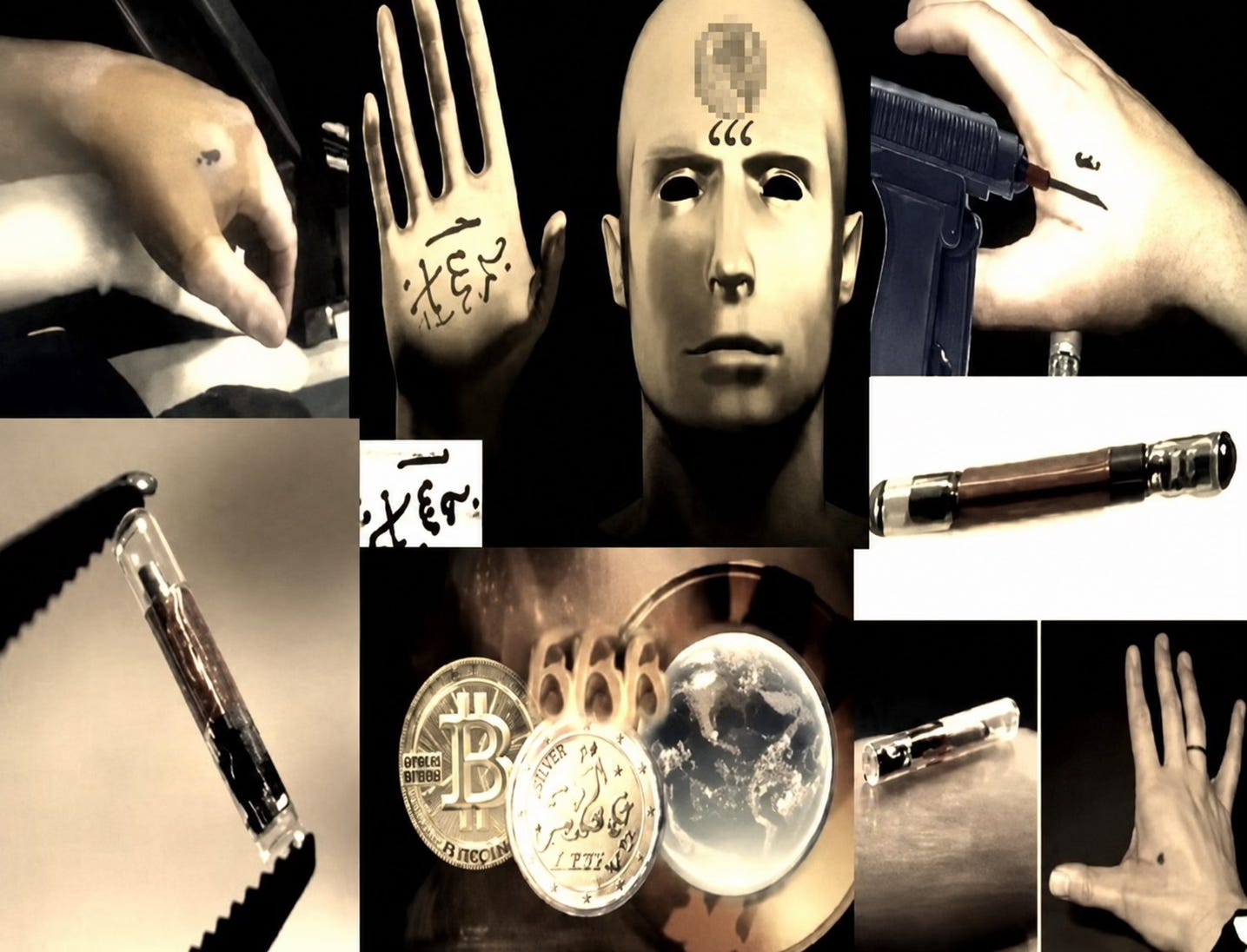
What they seem less inclined toward are the Alex Jones and Hollywood varieties of chameleon theory, celebrity orgies, and shape-shifting villainies, their attention instead drifting toward things more contemporary and, given their age, more relevant to them personally: tech companies, chiefly. The usual suspects are Palantir, Peter Thiel ‘the reptile, OMG,’ Baal translated into software, mark-of-the-beast infrastructure, corruption across the board, oligarchical arrow-pointing, Israel on a biblical end-times basis, transhumanism, freemasonry, microchips:
This basically. Short-sighted and mostly overwhelming.
I’d like to say there are many insightful, well-versed researchers, primarily on YouTube, that better share more nuances and seem more historically knowledgeable, and are interested in what they’re saying to the point of complexly producing it and mounting it to be seen. But the goal is the same, to me, even if not purported or intentioned by the initiate.
Evidently what matters here is not whether any of these people are right or wrong. I am not about to condemn with foaming vitriol what they’re saying—it is catchy, hookable, occasionally insightful. Nor is it really the content itself that concerns me.
You’re watching these videos, gathering information, parsing connections implied by the apparently seamless production some creator has assembled for you. You’re fairly sure of what you’re seeing and already sinking beneath the come-morrow implication that you’ll see things differently. You’ll be standing in a Walmart and begin having fractured yet enlightening observations about the crowd, what it all means, a rookie conception of nature and the degenerate current supposedly passing through it, and you’ll continue down the pit of, well, is this deliberate? Are we... fucked?
What seems common to all these theorists is that their information, in all its vastness and elaboration, eventually ceases to include you. Their knowledge, promoted as a means of guiding your sorry and uninformed self toward some dazzling truth, simultaneously carries the suggestion that whatever framework actually moves the world will permanently exclude you from it. Their bios, their captions, the hand-holding, the tantalizing guidance—all of it quietly begging the same inscrutable and somewhat tragic conclusion: that you are powerless before the truth they claim to possess.
Alright, what is this solipsistic attempt at interspersing you, curious you, into these broader theories? Initially, you didn’t watch these videos and catch up on these virtually exhaustive explanations in order to find your place in them. It had nothing to do with you, and so what? You didn’t want it to. You’re here for the TRUTH.
I’m speaking not of your immediate influence, or lack thereof, in this content, nor even of your interaction with it under the consequences of grating media consumption—do what you want, for as long as you want to. What I want to zero in on is the relational side effect of these videos and how, like a nasty ailment, they are prone to condensing the horizon of individual possibility. If you find yourself beguiled by them, even changed by them, viewing the world as more negative, more finalized, then perhaps you never had it in you to impose yourself upon it. If they leave you feeling down-and-out, you should not be watching them. You will not benefit from them, nor will anything shift upon your acquisition of this new compartment of futile expertise. You’re fucked not because the world sucks, but because you’ve been told it sucks, and your output has become an everlasting suck.
Revelation as commodity. History ferments this. People have wanted to know things about themselves, and about those around them before they happen, forever. They have always wanted prophets to lay the framework—these wants tend negative. People visit palm readers and sit cross-legged across from cardboard tarot cards in order to hear pessimistic outcomes that then justify what had previously appeared an inexplicable succession of bad events, the very events which prompted the spiritual gathering in the first place. Today the information is given freely, yet it still exploits that heralding desire in all of us and so remains, in its own way, a commodity.
One can certainly admit that the separation between ourselves and higher powers, whether government or God, induces a dehumanizing and disgruntled feeling in the gut. It makes us crave these foretold theories, these explanatory frameworks which satisfactorily etch us into place and thereby keep us moving in whatever direction we might have otherwise altered or redirected or abandoned altogether for something laborious but greater.
I wanted to write this essay because of a reel I watched. The others were largely asides, though still related to the broader picture. This particular reel consisted of a fastidious, down-the-line introduction into a certain popular figure—ahem, I won’t go further than that—and how, in summary, his rise was pre-planned from the very beginning. Pushed into place within some organized, highly elaborated ether wherein the options for inclusion are impossible and, since birth, certain figures are chosen, what appears to be distinguished will and a deterministic plight undertaken by some self-sailed charter is in reality a sealed certificate, a step-by-step lowdown issued before babe could suckle his first breast. I’m not being hyperbolic here; this is the theory.
Before I move on, a brief thought I had. Leftists believe in the blank-slate theory and right-wingers, in contradiction to this, are not supposed to support it, considering it as absurd as it obviously is. However, perhaps falsely betting on the presumption that this particular connecto-theory came from the right—or at the very least some granola-conservative sect—isn’t this merely a different shade of the same thing? Some preconceived communism? The conclusion appears different, but the machinery feels remarkably similar.

I’ve opened that which I shouldn’t have. This is not a nod to some horseshoe theory—I’m not a ‘catch your local pedo,’ capped-popcorn-ceilinged, classic conservative theorist. But it relates to what I’m saying.
As much as these theories unpurposefully leave you out, they leave the creator out too. Their claim to notoriety, and what grants them at least a grain of exaltation in the eyes of the hungry-for-answers public, is the insistence that theirs is a gospel of truth, an exposé into hidden power, the grinning Lucifer calcified within those already guaranteed money and fame—familial ties not included here—their lizard-damp eyes sketched eternally with worldly fervor, the ranks of which us embarrassing sheep can only covet circumlocutorily, that is, through long-winded schemes depicting an already chosen populace, and we are pushed to hate these people while moralizing ourselves in the process.
There is nothing we can do. With each morsel of confirming information as to the predetermined ecstasy granted to a select few, our inclination toward agency, our very real and often stifled desire to do, is reduced, and with it our agency itself. But something else happens too, because in the reduction of agency there is an increase in morality, or at least in our sense of it. What the theorists depict is evil; everyone and everything complex, distant, and outside our hands becomes evil, cabalistic, ritualistic, hush-hush, so that we, or rather you, can feel sort of OK walking around Walmart. The views are grim and immensely fattening, the people callous, though occasionally there is a nice cashier to retain balance, and anyway you’re so bloated with knowledge from reels that, well, what does it matter if the immediate world bends hollow? At least you know why, and whoops, that’s enough. And on top of knowing why, you know evildoers did it, and you’re standing right there, therefore you’re not evil.
Although this essay began with a screed against these moralistic charlatans, and despite these claims being hyper-specific so as to fit this particular phenotype, this happens everywhere. Downtroddenly incentivized theorists are but a niche minority and, insofar as you’re even moderately savvy with the algorithm, they can be swiftly avoided. What cannot be avoided is the persistent need—that which eliminates agency—for diagnosis. A simple and naturally human desire to stifle one’s own blame, project it elsewhere, becoming attached to a permanent diabetic jab-machine wherein you’re protected and monitored by an outside mechanism even as it pricks the skin and bleeds dry responsibility. It is a temperament you’ll find in everything and, more troublingly, in yourself. Immediately the feeling of losing one’s own narrative compels the psyche to reevaluate, to compose an alternative scenario wherein you’re outside, or on the offensive, or, contrastedly, doing good, and that’s assuming you even own up to what you’re either being accused of or accusing yourself of. Most don’t.
Everyone loves identifying themselves as self-aware, but what is this if not confirmation of some arbitrarily ambiguous intellectual status, one that precedes and later compensates for a neglectful streak of unsuccessfulness, an inability to bridge the gap between mental fantasy and reality? Perhaps we are influenced by the hundreds of people we encounter every day, and so if a creator spends a video ruminating over his manual breathing, you may begin doing so too. In the same vein, if a creator—perhaps one bent toward philosophy—begins speaking on self-awareness, you too may begin musing over your life and mistake this for accomplishment, because the creator is underground enough to appear in possession of some secret and novel power. You feel assimilated into something special, much in the same way those money-swollen enemies you believe to be devils are imagined as belonging to something special. In short, this contriteness disguised as self-awareness occurs constantly among people carrying the suspicion that what they’ve done has undermined what they wanted to do.
The only meaningful distinction between conspiracy theorists and a regular person, or a company, or a therapist, or really anyone who proclaims to tell you things, is that the theorist diagnoses you covertly while the others tend to do it directly. They diagnose world conditions in parameters that supply a kind of do-gooder fulfillment. Everyone identifies a root cause for inaction and then ceases to act. Given the cognitive effort required to arrive at these conclusions, assuming the subject is of average to above-average intelligence, though not by a long shot, the feeling of explanation begins masquerading as achievement and eventually as the process of achievement itself.
What happened when we were handed concessions so decorated and helpful, when modernity burgeoned this class of helpful people, these hundreds of thousands of diagnostic cretins, is that somewhere along the line awareness itself became a virtue separate from feats. At any other point in history, I think, this sort of thing would’ve either remained fandomless, been practiced in full incognito like the palm readers, or we’d have pushed these doomsayers down a mountain. I would’ve been the first iron-clad champ to do it.

What are these people then? All who implement these menially decided revelations that then, inadvertently, transfer over to the witness, bearing en masse a stamp of stimulated consciousness? I propose they are the second of three types of human beings. The first two often merge. There are different degrees of understanding of the world, however trivial, a vague sense of how things are done, how the world goes ‘round, and so movement between these types is possible depending on substance. To exist wholly within the first would require either a very low IQ or the temporary condition of being a child.
Number one is the unaware. Either these people are mentally retarded or blissfully capable of functioning within modernity without the sense of question. It simply does not occur to them. I know a couple of people like this and, to specify, this does not mean they are meekly moral, nor does it exempt them from culpability should they happen to be immoral. If they are not mentally retarded but merely lack that transcendent perceptive element, they still make decisions, probably work a regular job, could even be especially intelligent within that respective job. If you were to push them, you’d receive a vague nod and a trailing “yeah... anyway,” and that’s among the more intelligent of them. They are the wave itself, a current pushed according to the winds, though largely indifferent to the movement because movement has become routine.
Number two are the observers. These can be stupid, especially today, given the aforementioned Revelation as Commodity. Because one-sentence factoids and various philosophical wink-wink, nudge-nudges now cover the algorithmic terrain of the mildly interested, they acquire either a radically left or radically right disposition toward the world and feel entitled to it despite seldom interacting with the thing itself. If this disposition is not used to elevate them above those they imagine beneath them, it is used to fasten them into place, exactly as discussed before. They are generally normal-presenting people, perhaps some autists, perhaps some who know “things” but continue anyway in whatever worldly occupation they inhabit. Like I said, numbers one and two merge. If they subscribe to neither faction, they’re usually centrists, lukewarm types, or the insufferable “guys, it’s not left or right” variety. If you were to push them, you might rouse them, but before long you’d discover they repeat talking points. They are not the wave but the people caught in it. The current pulls them, they know it, and whether they drift with it or attempt swimming parallel depends largely on disposition.
Number three are the actors. Quite rare and, I don’t think, limited to positions of power. These are your great men regardless of notoriety, your meticulous philosophers and conquerors, your quietly satisfied people who leave you irked by an insight and a slow, brooding visage that seems to obfuscate them from explanation. You know they’re beyond you. They possess a certain distant look, a combination of far-removal and unusual closeness, sometimes even a contentfulness before the destitution of the world, as though from it emerges some great and individually possessed wonder. They are especially receptive to physical feeling and emotion. Everything bothers them and everything begets evaluation. There exists within them a peculiar need to process experience, one seemingly planted beforehand and prepared for intensive, oftentimes isolated, discussion. They do not merely notice things but become occupied by them. They are the sailors—perhaps preparing a dinghy by which to fight the current or drift against it, perhaps arriving in a cruise ship, perhaps in some wild and intrepid sailboat intended for military dominance. The vessel matters less than the fact that they are above the water. They are not the wave, nor are they caught within it; they contend with it.
“Only by resolving can a human being step into actuality, however bitter this may be to him. Inertia lacks the will to abandon the inward brooding which allows it to retain everything as a possibility. But possibility is not yet actuality.” —G.W.F. Hegel
I believe in destiny for personal reasons, though I believe it must be activated, cultivated, and plundered through. This could end negatively; I could be stifled, I may never rise to the ranks, however I am where I am for no legible reason. My childhood was spent envying lurid YouTubers and with my ignoramus face plugged into an iPad, and yet everything that has moved me has stood in direct opposition to the way things ordinarily move. My generation and those preceding it have, in their majorities, consistently entrapped me and, if not for this seemingly reasonless conviction to seize upon and process these questions, the very conviction which plunged me into adolescent misery, I would’ve drifted into the latter years of my teenagehood steeped in ressentiment. There is no way for me to escape these feelings, nor am I entirely convinced I should, save for sleep or death.
Because I am, surfacely, a normal person, I was taken for many years into this conspiratorial, diagnostic shithole. After an hour of watching these videos a palpable fever would come over me; strangely, though I was cold, my fingernails would turn purple, pricks would begin on my elbows, and an overall adrenaline would compel me to go outside, stare at something, relocate my boundaries, and accept, with the first intimate and consolatory caresses of piddling self-awareness, that I was a sweeping, dislocated speck. This became routine and, once it began intermingling with school and everyday life, I was taken to therapy.
My mom would trick me. Every day I would beg, through tears and thrashing, to be picked up early from school. Oftentimes a teacher would pull me by the feet while my mom, in tears herself, pushed my head back into the classroom like I was an inebriated ragdoll. Then, suddenly, she began picking me up early. Odd. She’d tell me in the car that she was taking me to the toy store. The brown-bricked administrative building that later entered my periphery was not, in fact, TOYS-R-US, though to disarm me she’d ensure I was taken there shortly afterward. My therapist was a fat, middle-aged, skin-tagged rag-tag named Doctor Dan, tall and reasonable, forever emerging from the building to placate me with assurances that he could help if only I came inside. Normally the same thing that happened between the school hallway and classroom happened there.
However, Doctor Dan did teach me something. I was only there for a handful of sessions, the strain eventually becoming overbearing, but he introduced a certain mental thought-project that I still perform to this day. At the time it was meant to alleviate my anxiety about school and sleeping in my own bed; today it promotes the very things that bind me to this previously mentioned destiny, while simultaneously saving me from being altogether consumed by it. The experiment is simple. Any thought you’re afraid of, any worry interrupting some mandatory doing, imagine taking it, crumpling it, throwing it into a trashcan, and then ejecting that trashcan off the slope of your brain into nothing-land.

I wonder if heifer Doctor Dan understands that his elementary concept of the Will is infinitely more vast and, as one advances in age, complimentary to every decision and every otherwise heckling vindication that there is virtue in the state of being psychologically cuckolded by pessimistic introspection.
Will should, ideally, presuppose these angsty reflections. If it does not presuppose them, that is, preexist eternally with positive connotations that waive, absorb, or cleverly implement what first appears daunting, then it should arrive afterward and be utilized for the same reasons. In order to participate in the world and mend your mind, willing it toward what could or could not be, depending upon your understanding and, perhaps, your destiny, you have to regard these diagnostics, these theorists and their ‘truth-telling’ badgering, as less something that provisionally rests the Will and pats it on the head, and more something that can be folded into a larger schema, into the Will’s eternal and, seriously, immensely helpful ability to be grasped and thereby transposed into what you, dear boy, have been called toward.
There is always the possibility that it is avoided. In fact, it is remarkably easy to avoid. You are seduced into avoiding it. You do not arrive at your destination by endlessly tracing your route upon a map. At some point, tedious though it may be, you have to travel.
I will leave you with a quote from the mustache man (no, not that one), Stalin:
“1) Weakness, 2) Idleness, 3) Stupidity. These are the only things that can be called vices…If a man is (1) strong (spiritually), 2) active, 3) clever (or capable), then he is good, regardless of any other ‘vices’!”
Really enjoying your work. Keep it up. Happy to have found something worth reading on here.