
Napoleon's Last Months
On the nightmare and a poem at the end

Napoleon was killed by the same disease that plagued his father: Stomach Cancer. For all the more formidable suggestions as to how a man of such feats could die, Napoleon surpassed them all—perhaps subversion of norms followed even into death.
Although experiencing briefly lucid moments to deal with matters of will and business, the two months before his death were, in my opinion, cause to see his death as one of the worst of all time. The details of such a devastating two months seek to, without meaning to, delegitimize Napoleon’s incredible, God-like plight and influence throughout the late eighteen and early nineteenth century. To me, these details contrarily deify him to a greater level, by introducing what inhuman, nightmarish tragedy followed similarly inhuman skill. Napoleon existed entirely on extremes, both in military prowess and intelligence, so it is equitable that he suffered the way he did. One could in this way compare him to Christ, but of course loosely.
Not many really want to know what occurred from Mid March of 1821 to May 5th, the day of his death, in which time he was bed-ridden. Not many know what torment Napoleon went through, what horrors and ill-performed remedies he consumed, what thoughts must’ve circulated what dwindling consciousness he possessed. However, it is documented with a fastidiousness that unsettlingly allows one of modernity to see, and even feel, what he went through. Upon my short period of research last night I was struck with a sickness that left me unable to sleep. I don’t intend to pass these feelings onto you. In fact I write this with no purpose other than to describe it while preserving some dignity to a man I consider in similar sensitive soul as I.
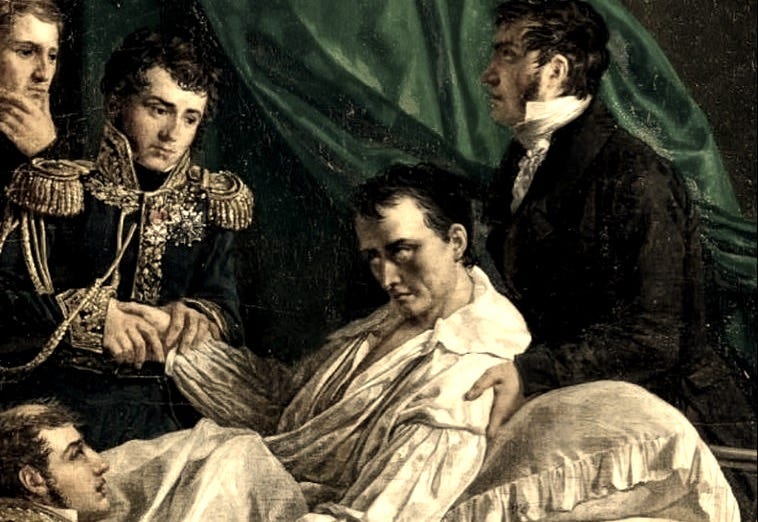
Specifically I was struck by the painting above. Many paintings depicting Napoleon’s last days consist, if they sought to caricaturize him, of a bloated, coughing and hideous man lost in the breadth of his failures and commented on as such.
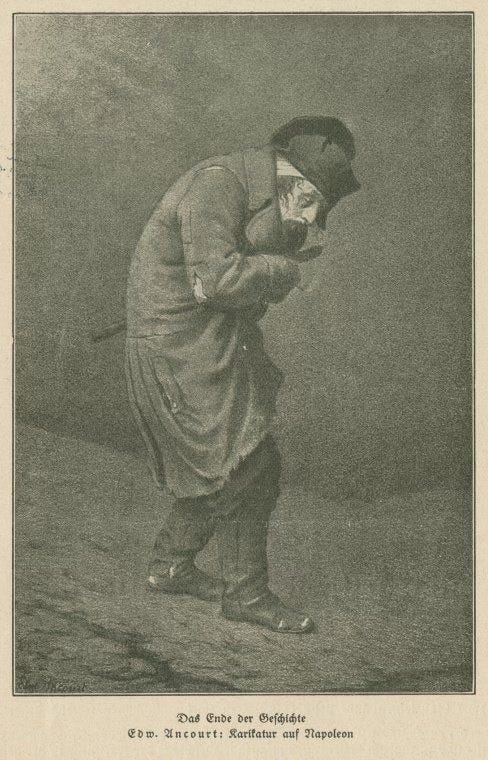
If not that, then the same pot-bellied, brooding creature walking the foliage of St. Helena. While Napoleon was heavy in his latter years he lost significant amounts of weight because of the Stomach Cancer, which prevented him from eating. In addition to this obvious detail, he was described as, because of these constant illnesses, as having a gaunt, sallow face despite still being mildly overweight (at that point he had a BMI of 27). No matter these vitriolic depictions, the painting in the bed is, to me, evocatively moving and, I predict, more accurate. Here we can indeed see Napoleon is exhausted, howsoever weakly regarding his contemporaries who support him, dampened and reflective and dare I say beautiful. In spite of his eyes consistently painted as understanding, receptive and even vulnerable, I see in many instances a fortification. It is in this painting too. The ‘World-Spirit.’
German philosopher Hegel, writing to a friend about Napoleon: “I saw the Emperor-this world-soul-riding out of the city on reconnaissance. It is indeed a wonderful sensation to see such an individual, who, concentrated here at a single point, astride a horse, reaches out over the world and masters it.”
Forty-eight out of forty-eight days of his sickness at its peak was spent braving severe abdominal pain. His stomach was oftentimes distended and cramping and prevented him from much movement at all. External conflicts that once framed his fruitful life now faced entirely in the body. On thirty-two of those forty-eight days he is documented as vomiting, and rarely kept anything down. In the final weeks he was hiccuping persistently. To think of this realistically once must imagine a worse type of Norovirus lasting two months and killing you. It evokes sweat and haunting feelings of immobility and spit-pooling. Of course, atop these daily symptoms came a range of others to accompany these already debilitating ones—anemia, dehydration, tachycardia, aversion to meat (food in general), and delirium.
Listing these afflictions feels honestly like brutal tallying. It is difficult to put you into the perspective of what he suffered because many are simply commonplace asides to a cancerous disease. To gravely and gorily illustrate a day-to-day of this Emperor would be indignifying and without a cause; you know the pain abstractly. Doctors tried everything to stave the ongoing ills but such is Cancer and his autopsy reports proved what he had was, inevitably, going to kill him. In what delirious pain he used to writhe and moan ‘My God!’ and what heart-breaking visualizations that induces.
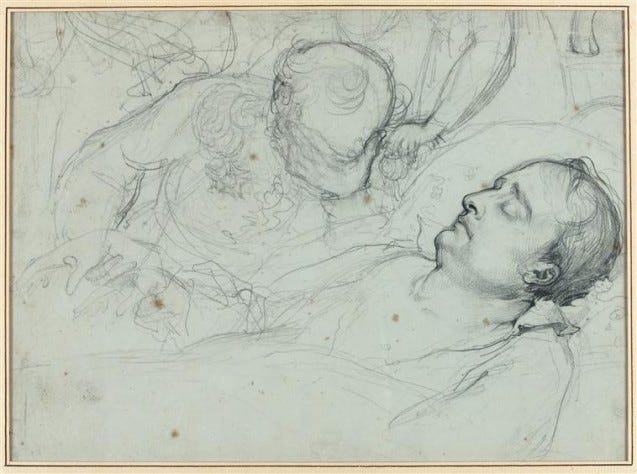
Here we see an upset Grand Marshal Bertrand alongside a half-sleeping, wistful Napoleon, hand in limp hand.
Roughly 1-2 days before his death, a murmuring and weak Napoleon was given a large dose of calomel, a common laxative used at the time. This was a decision first prompted by British doctors and was subsequently overruled by their votes against the wishes of Napoleon’s Physician, a Francesco Antommarchi. Initially this laxative appeared to aid in Napoleon’s problem of constipation, but eventually it became something that, while not causing his death, greatly accelerated it. After it was administered he, internally irritated, vomited digested blood, and was shown to have a stomach full of bloody, eroding material.
It is perhaps wishful thinking of mine to hope his feelings of malaise and queasiness were something he’d gotten used to, would relate humor towards, however strenuous a task it may have been.
But I am not sure. As Napoleon is often portrayed as the intrepid man who danced the domination of European civilization, tantalized everyone who was lucky enough to have seen what deterministic soul inhabited this Corsican born French nationalist, one may, given an unknowledgeable idea of him supported and born majorly of takeover edits and bad-assery speeches intermingled with his most famous portraiture, many of which seem to model Hegel’s powerful idea of his only once witnessed hero, see him as an entirely cold, calculated, hollywood-ified individual—this is how mass media tends to highlight significant figures. In many ways it is true—these types of greats have to possess an impenetrable level of ego that precedes their victories and afterwards, begrudgingly, explains them (many archetypes of great characters in media and even literature have the ‘but I didn’t ask for this!’ quality that is often the inverse in real life), they must harbor a futuristic view that proposes them as the primarily propellers, and without this initial root of hope combined with an understanding of inherent human superiority they would relinquish what traits they claim to divinely bear and sequester in the passage of time. With that said, strictly psychopathic, callous and uppity do-it-all types are not those at the level of Napoleon. I notice many equate that type with the greats—and if one is not completely dim I imagine this could, with simple research, be disputed. This has nothing to do with the inherent goal—it is moreso related to the personalities behind these goals, howsoever they were good or bad in the end, because such redundant moral arguments can be debated into the grave.
While these sorts ‘make it’ in the world, even reaching reputable heights, it’s of a much lesser degree and they are not so touchingly recalled by those down the line. The reason why figures like Napoleon and those whom he himself revered are remembered in a distinctly different way than those who only CLAIM to emulate their trivial capacities is this: sensitivity1.
Napoleon’s early life, and glimpses of his later life besides the vast military accomplishments and shaking triumphs, show an embarrassing but endearing amount of receptivity and introspection, all of which coincides with the sensitive conclusion. Although displaying an astute and orderly exterior in his actions, his personality, at least on the surface, appeared to contradict it. This—a combination of sensitively yet NOT dwindled by preventive anxiety, which is to me Satan’s primary weapon for sensitive types—is incredibly rare.
This is unfortunately summarized—I could write a more comprehensive article on this ALONE.
However, pain to such an abominable scale as that which Napoleon dealt with throughout March, April, and May did not need anxiety to be sufficiently destructive, and given these revelations I don’t think he ever relaxed nor accepted it, was never less upset when he felt the nausea rising, the stomach hard and uncomfortable—again, extremities. He felt everything so wholly his entire life.
"I feel myself driven towards an end that I do not know. As soon as I have reached it, as soon as I shall become unnecessary, an atom will suffice to shatter me. Until then, all the forces of mankind can do nothing to stop me." —Napoleon Bonaparte
Poem by me:
Soot-footed Buonaparte
Lands trekked, interfaced across the blisters and textured skin.
He lay half-holy in clean linen and washed soles,
everything dirtied in conquered mountains,
homesteads stomped beneath the stylish boot and pomp,
ravaged inward to soil the gut.
I once, many a once, sent my battalions mad.
My crew, the loved ones, overstepped grasslands
and peoples whose names I knew only as foreign.
They welcomed me with sweet smiles and surpassing goals,
with dreams no lowly man but I
could bring through great ache and acre
into what they ought to become.
I seek the blossomed conjuring of my mind,
visions aglow in the uncaring measure of many.
They see me as lacking talents equal to my view,
which I hold in dear consideration, my babe.
Fate, I knew well, would dismantle all before me.
Interested, yet never saw it done rightly,
I shall do what I am meant. To.
Enshadowed by the trees of Italy, I bear my Roman salutation.
In Egypt, I stand sword-bound, releasing begotten French fury.
Before Pius, beneath thine pious eye, sweet-visaged,
a laurel wreath crowns me,
each leaf echoing a thorn-blade to the forehead.
Aperture of destiny, there it bleeds, I say:
I am Napoleon.
The instincts of youth squander the body of age.
He lay with churning pain, reflecting each
out-pulsing of that tumultuous guide once his own,
now espoused in organs which plead a folded,
cancerous fate for all his expansive needs,
sketched in monstrously tortuous functions.
The Emperor, hunched, sees in his secret erosion
how the meek are burdened in likeness,
how God grants the deadliest maladies
to His most self-same creations.
I am aware of the growing rise of young men thinking they are sensitive. I venture to believe the ones who purport this online are not, and from my view lack personality and are often unwarrantedly cruel (sensitivity requires empathy, and empathy can be used tactfully by brilliant minds, namely Napoleon), and the ones who ARE are completely unaware of this trend. Like everything else, it is a trend. Also like everything else, people love to claim that which they aren’t. Maybe I do the same.