

Poor Mitch
Short Story about a Gen-Alpha
Johanna sprawls. She is a translucently pale-skinned woman in the cicada-screeching Summer environment. Gracefully maternal, immune to social criticism, a perfect sect of shapeliness and fertile body sitting gleaming like light through opal, pleasantly maimed by the Sun’s rays. Her stomach is tucked neatly into high-waisted bikini bottoms, her top modest and glittering cerulean, and she remains uncompromised by outsider trends or comments which desecrate her, as they usually do plumper women regardless of circumstance. One fat-calfed knee is hitched near her left buttcheek, ankle raised and making small circular whirs in the air, popping every so often.
She has the atypical political indifference, admirably so, of an elementary school teacher untouched by hours on the phone—not because she knows better, but because she simply does not encounter what so hastens other teachers, perhaps those of more urban communities, who flood their classrooms with ideals. Johanna dedicates her days gleefully to her children, to concerns of park safety and the health of adrenaline-sick toddlers in her classroom. A sweet teacher one remembers through time, who rubs the back of a child feverish from hot recesses and ensures parents will be called, sits momentarily and beautifully as a stand-in parent, lifts lukewarm water to their lips, and sweetly repudiates the accidental slip of being called ‘mom,’ though tenderly she loves it. All these children are her children’s faces: flushed beneath clothing too large, involuntary turns of petite limbs, scentless sweat, crying in horror at their own messes. It is so unlike the others.
She kisses the supple concave of her daughter’s dimple and removes her sunglasses to playfully give them to her. They slip off. Her big blues are shielded by sway of french-tipped nails to her forehead, supplanting the sunglasses which now lie on the beach towel. She is so happy, giddily distant from herself, immensely and by existence alone refuting worlds of claims most dominant online, embodying the Seussian sketch of beauty in thought and consequently radiating the features. She is incompatible with many and hated by most. She doesn’t know or care.
Mitchell Burnard exits toward the back porch. He is still young, old enough to have a faint disgust for sentimental things, young enough to nearly cry from those same sentiments, alone, in the dark. The grass is freshly mowed by Johanna’s husband, Daryll. The picket fence is laden with wipes of soil and fine fissures. Upheavals of thin, true grass wave in the meek breeze. Lawn chairs sit displaced with wet swimsuit outlines disappearing from their material in the heat. Little opaque pacifiers of old rest on a granite counter where, shaded by angle, Daryll flips a patty and fleshy, amoxicillin-pink flashes upward toward the sky.
Grass touches sharp against Mitchell’s feet, wet from sprinkling, residual tendrils clinging along with dirt to the soles. Sticky suburban summers spent tanning out back. Johanna is supine, keeping a palm gently set on her daughter’s back, who thoughtlessly grasps the sunglasses with stout fingers, fantastically awed by their bending, by the metal mechanism. Mitchell sits down, creating a slight crease in the towel.
Johanna’s daughter notices the ring between hinge and temple and sets a fingernail upon it. One extra bend, an inch more, and she’d get her nail caught. Mitchell gently, without disconnecting her grasp from the sunglasses, pulls her finger from the bend.
She looks up at him, becomes astounded by the sunlight, then grimaces and plants her head back down.
Mitchell laughs and gives a quick kiss to her cheek.
“Mitch, you want cheese?”
“Yeah. Thanks.”
“No prob’.”
“Oh, Mitch,” Johanna sits up, shading herself again, “When’d you come out?”
“Just now.”
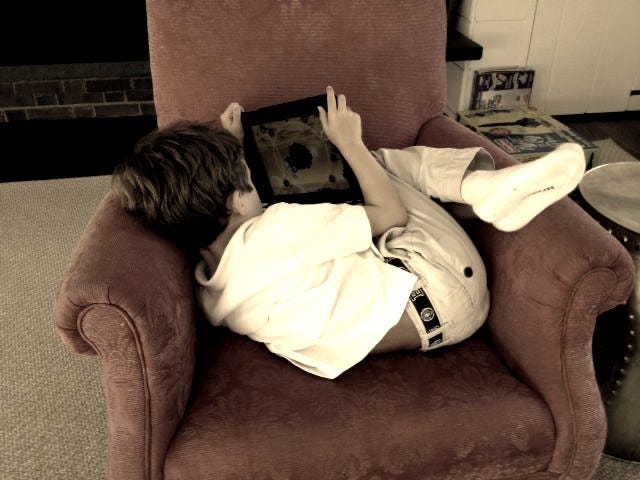
“No iPad,” she says observantly.
“It was giving me a headache.”
“It’ll do that. You oughta stay out here a while. Sun’ll make ya feel good.”
“Think I’m gonna grill some onions,” Daryll says. “Caramelize ‘em. Sound good to anybody? If not, I’d just eat ‘em.”
“Mm, yeah, I’ll do that.”
“Hey, I gotta watch these. Mitch, you mind grabbin’ ‘em?”
“Yeah, I can.”
“Thanks, kiddo.”
Mitch has periods of restlessness when he spends too long online. Something about the air conditioning, the redundancy of the videos, the countless upticks during introductory segments, the same hauls of toys and small roleplay talk—there’s no change to many of them, so he resorts to the outside again, and he likes being given tasks.
Standing, he feels his nimble knees twitch and walks past Daryll, back inside. Daryll shoots him a smile with a smoking-gun finger.
You’re the man.
He passes into the kitchen.
His mom, corpulent especially through the torso, comes in from the garage door. She wears glowy sneakers with heavy bottoms, black latex leggings, and a shirt too small for her. Her hair is an amalgamated rainbow. The sun still grazes Mitch’s eyesight in little black bursts, making her short, choppy look seem blinding, epileptic. Her gait is always assertive, as though perpetually frustrated or perpetually bracing for some great angry outburst. Both could be true and both seem to last forever.
Mitch’s baby brother Sailor, wispy curls and purpled eye-bags lending a downtrodden element to his entire face, walks in with his device in hand. Upon no request, he drifts toward the living room, cut off by a small alcove, and plops onto the couch, licking some circular crumb from his index finger.
A shadow of a curl dips above the couch. Mitch’s stomach hurts.
His mom slams the grocery bags onto the counter as Mitch crosses to the fridge, a great mixture of condiments and frozen concoctions, leftovers from nights past building condensation on their tupperware walls. He presses a thumb to his eyebrow to alleviate the headache strain.
There is a kind of sheen on everything, and it is indecipherable.
“Mitch.” His mom says solidly.
Mitch strains his eyes, looking for some pre-chopped onions.
“What.”
“Um,” she begins coolly, “what’re you doing?”
“Looking for something.”
“Ya walked right past me, kid.”
“Daryll wants onions.”
“Yeah. There is none.”
“Oh.”
He shuts the fridge door. Its suction pulses for a second longer.
“Standin’ like a tree stump. Get over here and help me out.”
“Did you buy onions?”
“No.” Sardonic, she raises her brows. “Didn’t get the memo.”
“I guess he thinks people have onions in their houses.”
“Too bad. We don’t. Pickles in the fridge, Mitchell. What’re you doing.”
“I was setting ‘em down. I was gonna put ‘em in the fridge. I wanna tell him there’s no onions.”
“You put ‘em in the fridge first. Everything that goes in the fridge, put in the fridge, bucko.”
He looks at his mom. He picks up the pickle jar and places it onto the second shelf. Large whooshes of cold air make him feel digitized.
“I got french onion dip. How about that.”
“He wanted them grilled, I think, Mom.”
“Whomp whomp. Gonna sit down for a second.”
“Sailor is getting cheesy hands on the couch.”
“Yeah. And you don’t?”
“I was just saying.”
Out of one of the grocery bags, this one plastic rather than paper, she pulls a bag of coated, flavored potato chips and sits, elbows to the counter. Her phone case, one among many designs and stickers of her choosing, lies flat on the counter as she presses the side button and powers it to life. Mitch is sad there are no onions, and he feels distinguishably unfit to be in this predicament.
His mom tears the bag sideways and settles halfway onto one of the barstools, pushing harshly at times to get herself comfortable, brushing a colored bang from her face, hastening herself toward her app, bent over with focused prowess.
Sailor shouts chants he hears from his iPad into the interior. Mitch recalls, suddenly and with grave, almost life-ending anxiety, that he must show face at a Fourth of July barbeque the following weekend, much like every previous year. Big Brandy, his fourth-grade teacher, brings an entire fast-food heap for breakfast every morning: biscuits drizzled in thin powdery frosting, sausages hard and round as hockey pucks. Aptly nicknamed “Big,” she often forces him to eat her potato salad, into which she adds bacon. It is alright, but barely cold once sweat runs in rivers down their armpits and the festivities wear on.
Every year he vomits red Gatorade mixtures into Brandy’s backyard. It has been this way since first grade, and he cannot refuse Big Brandy. Johanna celebrates with Daryll’s family and her biological father, so she is never there.
These are the horrible, dreaded stomach bugs.
He cannot stand that they befall many children in his class too; nothing is exclusive, everything is known as something, every ailment accompanied by a word. He is not anybody, even in this tradition of eating himself sick.
After the potato salad is shoved generously down the gullet, along with helpings of brown sugary canned beans and barbeque pork cut into slits, the neighborhood children fancy themselves energized and want to ride Big Brandy’s one-ton horse, Sir Agape Bobbysocks. Food hangs and bobs in the stomach. The tradition—the thing which makes Mitch annually sick—is called “Bitch Mitch.” It is that, somehow, whenever it is Mitch’s turn to mount Agape Bobbysocks, the horse defecates. He leaves a heap of excrement on the grass beside wherever the picnic tables happen to be, and before Mitch can hop off, the horse begins a maddening, trembling dance. Big Brandy’s arthritis-friendly tennis shoes soak in manure as she holds Mitch atop the horse, and every time Bobbysocks raises his front legs and threatens movement, Brandy clutches tighter around Mitch’s abdomen.
Everything squelches.
The easily spreading smell of horse manure, mingled with the hot foods both in and around him, makes Mitch sob in horror. He feels the familiar dampness begin to coat his mouth and, to alleviate the looks of the other children, attempts to play it off. But this is what Mitch is meant to do. This is his calling.
During this time, Mitch’s mom is accompanied by her gender-ambiguous friend, from whom she purchases pins, drunk on off-brand beer and floating endlessly through Big Brandy’s aboveground pool in a one-piece with some sort of tutu at the hips, every minute or so heaving with laughter, joking voices, false hope, a high-pitched “ye’ can do it, Mitch,” an “ah, oh, hold on Mitch,” followed by a typically masculine sounding “that’s m’ boy!” though it is not validating, not a challenge he wishes to undertake, and meanwhile Mitch’s dad, Lee, talks inside and under his breath about his video game scripts, many of which sell poorly because of his habit of overwriting gore, hushedly mentioning “visions” or “they don’t get what I’m trying to do,” three fingers constantly stretching his already outstretched earlobes in some soothing ritual, a skittish man of forty with no accent and a coarse, peppery buzzcut.
Mitch advances into an overstimulated scream as ensembles of children with clunky phones take shaky videos of him, Big Brandy leaking soupy-sweet perspiration from undisclosed places, her face grainy as though put through a blender, and eventually he has to thrust himself from her grasp and, because no one comes to help disconnect him from the horse, falls onto his stomach, luckily clear of the manure, before running behind the pool to vomit.
This scene is unlike anything else to him.
Bitch Mitch in the athletic tee-shirts and mesh shorts, lego hoodies and low-topped converse, bearing thinly the cross of accidental humiliation; children not knowing what they were seeing, only that they would see it every Fourth of July. Forgive their sullen, pumped faces.
This is the age where one inevitably belongs to, and is brought along to, their parents’ outings. Babysitters are too expensive and Mitch’s mom is afraid of heresy evading her home, that is, not of the religious sort. Mitch preemptively grieves next weekend, and now he is even more nervous to go out and inform Daryll of their onionless domicile.
He hears Johanna’s baby daughter begin to cry outside. Frenetic, dumb-struck baby cries, their wandering and clueless edge reverberating across the vinyl floors of the house and shaking him up. He feels as though he should be permitted to remain in his room forever.
There is nothing to do on these brisk, blinding Sundays where the whole world fills with an unquestionable monotony: Lee mapping whiteboard-style storylines which appear constantly transversive and abounding when truly it is only that he has unlocked this “quantum realm” instinct permeating the minds of half-brained conspiracy theorists and now implements it everywhere, while Mitch’s mom, Roxy, plays freedom fighter on the internet, complaining that her movie-franchise-themed nails prevent her from typing vigorously, complaining as though this inconvenience arrived from some external source and not herself.
Mitch does not know anything about history. He is instinctually bad at English, breaks flasks in science, and is vexed to tears by math with letter variables. He has no interest in the brooding caress of some other world and the men who desire it because he has never truly been introduced to it. He knows not of America but only of George Washington crossing the Delaware, that first glimpse of man and ambition—interchangeable things when hope is involved—which he recreated once in kindergarten for an assignment with cotton-ball aristocrat wigs and red play-doh rosy cheeks, stick figures for the other patriots, Big Brandy in that year heavier and hyperventilating down the halls. He knows not the scourges of Christ but tweedle-dee drums and electric guitars and pretty girls handing out cheetos at concession stands in church, bishops in indiscriminate vestments of all sexes and indignifying appearances, children sneaking around back to steal more snacks, viperous without understanding why. He knows not of their prayers but of merchandise sold in church apart from worship, which he buys because there is something special about purchasing things when young, with chore money earned from checking off magnet lists on the refrigerator. He knows not of the evening Napoleon fled the men who spread rumors of his betrayal after proclaiming Corsica not for the English to take, banding forth with his family to Toulon, a brilliant mind touching soil in need; it is arguable he knows of Napoleon at all.
He knows not of the decades of struggle which physically and militarily permeated those who desired difference and altercation, fervent kinds of all colors and creeds, emboldened by their passions and often propped up by many who thought the whole affair a comedy, a spectacle of cinema themes and revelatory music scores, much like his mom, and yet those whom she could not touch had nevertheless understood it, whether mildly or profoundly, and fought all the same. They fought with strife and with some real sense of entitlement, because even in outright evil there exists, detached from the evil itself, a first watchful eye turned toward suffering and maltreatment, powers that be corrupting and enslaving powers that could be, the young disrupted and proclaimed hazardous for no clean or definable reason. One man sees these things and seeks to pulverize them, joining together others who will see once given eyes and realization, and if evil does come of it there was once, before all else, that confirmed and unifying feeling, that skyward-looking presence of fullness which gathers itself in the chest and insists something must be done.
But Mitch could, if asked on a test or in person because of what he has learned in school, tell you quite a lot about years and dates correctly, though not quite what any of it means. He will never know what any of it means, though he possesses many of the same feelings but remains estranged from them.
He tears between inside and out, listening to Johanna sing to her daughter.
This is really well written